
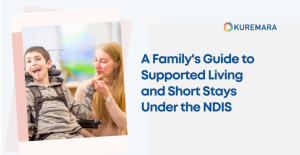
For many participants and their families, the question of where and how to live sits at the heart of the NDIS journey. Supported accommodation can transform daily life, offering the right level of help to live independently, the chance to try something new, or simply a safe and welcoming place to stay while a carer takes a break. Yet the language around it is dense, the options overlap, and few people are told plainly how it all works. This guide sets out what supported accommodation involves, how the models differ, and how to choose a provider with real confidence.
Why Where You Live Shapes Everything Else
Housing is rarely just about a roof. For people living with disability, the living arrangement determines how much independence is possible, how connected a person feels to their community, and how well their support actually works day to day. A well-matched arrangement can unlock genuine progress. A poorly matched one can quietly hold someone back for years.
This is why accommodation deserves more thought than it often gets. The right setup builds skills rather than replacing them: helping with the parts of daily life that are genuinely difficult while leaving room for a participant to cook, budget, socialise, and make their own decisions. Good support fades into the background as capability grows.
For families in the region weighing their options, understanding what capable SIL providers on the Sunshine Coast genuinely offer is the essential first step. Differences between providers aren’t cosmetic. They show up in whether staff are consistent, whether housemates get along, and whether a participant is moving towards the life they actually want.
The Accommodation Models, Explained Plainly
The acronyms are the first hurdle, so here is what each option actually means and who it tends to suit:
- Supported Independent Living (SIL).Help with everyday tasks in a shared or individual home, designed so a person can live as independently as possible. Support is tailored and can range from a few hours daily to around-the-clock care, typically covering personal care, meals, medication, and household routines.
- Individualised Living Options (ILO).A more flexible alternative to SIL, offering greater say over how and where you live. Rather than a fixed model, supports are built around a person’s own routines, relationships, and goals, which might mean living alone with drop-in help or sharing with a host.
- Short Term Accommodation (STA) and respite.A supported stay away from usual arrangements, usually a few days at a time. It gives participants new experiences and social contact while family carers rest, and it’s frequently used to trial living arrangements before committing to anything permanent.
- Medium Term Accommodation (MTA).A bridging option for participants who have somewhere permanent to move into but can’t yet, perhaps while a home is being modified or a placement finalised.
- Complex or high-intensity accommodation support.For those with significant health or behavioural needs, some settings are staffed by workers trained in clinical and high-intensity care, always delivered in line with treating clinicians’ instructions and the participant’s approved plan.
These models aren’t a one-way street. Many participants move between them as life changes, using STA to test whether shared living suits them before committing to SIL, or transitioning from SIL to ILO as independence grows. A good provider helps a participant find the genuine fit rather than steering them towards whichever vacancy happens to be open.
What Actually Separates a Quality Provider
Provider websites tend to sound alike, so knowing the substantive markers of quality helps you look past the language. These are the factors that make a real difference:
- Registration with the NDIS Quality and Safeguards Commission.Registered providers are independently audited against the NDIS Practice Standards and held accountable for the safety and quality of their services. This is your strongest external assurance, and it should be the first thing you verify rather than the last.
- Properly screened and trained staff.Every support worker should hold a current NDIS Worker Screening Check. Beyond the minimum, look for genuine ongoing investment in training, particularly for high-intensity supports where competence directly affects both safety and dignity.
- Consistency of support workers.Familiar faces matter enormously in someone’s own home. Providers who prioritise continuity, rather than filling shifts with whoever is free, build the trust that makes accommodation support genuinely work.
- Thoughtful housemate matching.In shared settings, who a person lives with shapes their daily happiness more than almost anything else. Quality providers take compatibility seriously, considering interests, routines, and support needs rather than simply filling an empty room.
- A genuine focus on building skills.Good support actively develops independence, teaching cooking, budgeting, and daily living skills rather than doing everything for the participant. Ask directly how a provider measures progress towards goals.
- Open complaints and feedback processes.Reputable providers make it straightforward to raise concerns, document and escalate them properly, and respect a participant’s right to take matters to the Commission. Comfort with that question tells you a great deal about the culture.
Measuring providers against these criteria turns an intimidating decision into a manageable one. It also protects participants, because the gap between an excellent provider and a mediocre one is felt daily, not on a homepage.
Why Availability and Reach Matter

One practical reality families quickly discover is that accommodation depends on vacancies. A provider might be excellent on paper, but if there’s no suitable place available, or no compatible housemate, the fit simply isn’t there yet. This is why it pays to look at providers with genuine scale and an established presence rather than a single small operation.
Larger, well-organised NDIS providers on the Sunshine Coast and across South-East Queensland are more likely to have options coming available, more flexibility to match participants thoughtfully, and the staffing depth to cover shifts reliably. Depth of team also means clinical capability when it’s needed, with nurses and trained practitioners available rather than support workers alone.
There’s also value in a provider whose services sit under one roof. When accommodation, in-home support, community access, nursing, and support coordination all come from the same team, information doesn’t fall between organisations and participants aren’t left repeating their story. That coordination shows up as smoother, more consistent care.
Kuremara is a registered NDIS provider delivering SIL, ILO, short-term accommodation, complex care, community nursing, and support coordination, with teams across South-East Queensland as well as Sydney and Melbourne. You can explore their services and current vacancies at kuremara.com.au.
Questions Worth Asking Before You Sign
A few direct questions before signing a service agreement will tell you more than any brochure. Ask how support workers are matched to participants, and whether you’ll see consistent staff or a changing roster. Ask what happens when a regular worker is unavailable, because continuity planning reveals how well-run a provider genuinely is.
For shared living, ask about housemate matching and whether you can meet potential housemates first. Ask to visit the home, ideally more than once and at different times of day, and notice whether it feels like somewhere a person would actually want to live. Ask how participants are supported to build skills and pursue their own goals, and how frequently plans are reviewed.
It’s worth remembering you’re never locked in. Funding follows the participant, not the provider, so you can change if an arrangement isn’t working. A reputable provider handles that transition gracefully and coordinates with your support coordinator to keep supports uninterrupted.
Taking the First Step
Starting the search can feel daunting, but no one has to do it alone. Reputable providers offer a no-obligation conversation to understand your situation, answer questions, and be honest about what they can and cannot deliver. That first call is genuinely revealing: notice whether they listen properly, explain things clearly, and show real interest in the person rather than the plan budget.
The most capable STA providers on the Sunshine Coast, and accommodation services generally, always begin by understanding the individual: their goals, their support needs, and the people already around them. From there comes a tailored plan, an introduction to the team, and often a short stay to test whether an arrangement feels right before anything permanent is agreed. Taking that first step, simply picking up the phone, is usually when the whole process starts to feel manageable.
Conclusion
Choosing supported accommodation shapes daily life more profoundly than almost any other NDIS decision, and it deserves proper thought rather than a rushed signature. Understanding how the models differ, knowing the real markers of a registered and capable provider, and appreciating why availability and coordination matter all give you the confidence to choose well. With the right provider alongside them, participants can build genuine independence, form real connections, and live somewhere that feels like their own home. If you or someone you love is exploring these options, reaching out to a registered provider for a friendly, no-obligation conversation is a sensible and reassuring place to begin.